Friday, March 13, 2020

Another Decade - Part 2

In a decade where social media's explosive diversification made self-conscious performers of us all, the art of acting's salutary role in our societies became clearer than ever before. No matter the medium, genre or characters, actors all share one common purpose: to clarify emotions, thoughts and impulses that are, by nature, never clear or easily understood when we experience them. While our digital age's emphasis on conformity, groupthink and self-presentation encourages us to carefully tailor our experiences and expressions to predetermined audience expectations, the best film performances of the 2010s took us outside our comfort zones and into new realms of emotional understanding.

To pick only 30 out of the many, many acting feats that touched my heart this past decade was a cruel challenge. From career highlights by veterans such as Ethan Hawke (First Reformed, Maudie), Willem Dafoe (At Eternity's Gate, The Florida Project) and Cate Blanchett (Carol, Blue Jasmine) to revelatory turns from bright stars like Tessa Thompson (Dear White People), Juno Temple (Killer Joe) and Daveed Diggs (Blindspotting), there is a myriad of outstanding performances from some of my favourite actors that didn't make the list. These include gems from established thespians like J. K. Simmons (Whiplash), Tom Hardy (Locke) and Adam Sandler (Uncut Gems), as well as unknowns like Lily Gladstone (Certain Women), Bernard Pruvost (Lil' Quinquin) and Adam Pearson (Under The Skin). I can only hope these omissions give readers an idea of how truly exceptional the following performances are.

Honourable mentions:

- Steven Yeun as Ben in Burning (2018).
- Timothée Chalamet as Elio Perlman in Call Me By Your Name (2017).
- Daniel Day-Lewis as Woodcock Reynolds in Phantom Thread (2017).
- Cynthia Nixon as Emily Dickinson in A Quiet Passion (2016).
Viola Davis as Veronica Rawlings in Widows (2018).

30 - Ronald Bronstein as Lenny Sokal in Daddy Longlegs (2010).
As a screenwriter and editor, Ronald Bronstein has been the Safdie Brothers' secret weapon, the frantically beating heart pumping life into their chaotic New York head-trips, infusing them with the same desperate need for human connection he visualized so brilliantly in his little-seen 2008 directorial effort Frownland. As the irresponsible titular dad in the brothers' sophomore feature, that crazed energy animates every bone of his long-limbed body, turning every activity into a madcap adventure he alone experiences, in a maddening display of despair-tinged histrionics that's impossible to look away from - no matter how much you may want to.

29 - Peter Simonischek as Winfried Conradi/Toni Erdmann in Toni Erdmann (2016).
If you thought Lenny was an especially aggravating "cool dad" wannabe, Peter Simonischek's Winfried Conradi is the kind whose mere presence could serve as the ultimate test for sainthood. Neither manic enough to be labelled insane nor openly needy enough to solicit pity or revulsion, he irritates and confounds by continually wrongfooting our emotional expectations and making his antics as much a stonewall for his feelings as a clumsily-improvised bridge to reach out to his workaholic daughter. Like a German Andy Kaufman, his stubborn deadpan forces us to exhaust all our programmed responses until emotion gradually emerges, unexpectedly, as if it had been staring us in the face all this time, waiting for us to notice it.

28 - Issei Ogata as Grand Councillor Inoue Masashige in Silence (2016).
Martin Scorsese's under-seen meditation on faith, ego, power, freedom and cultural conflict boasted magnificent performances across the board but none managed to distil these aforementioned themes as succinctly and as colourfully as Issei Ogata's crafty anti-Christian inquisitor. Alternating between comical impishness, ruthless calculation and smiling affability, Ogata makes Masashige a marvellously complex embodiment of the very human forces and rationales that dictate the politics of religious oppression. It's a mesmerizing performance of deceptive subtlety that blurs lines between reason and folly, truth and falsehood, good and evil - as all good spiritual challenges do.

27 - Lesley Manville as Cyril Woodcock in Phantom Thread (2017).
Lesley Manville's nigh unmatched ability to completely disappear into her characters has always owed a lot to the beautiful ordinariness of her face. That face, with its blend of multi-faceted expressiveness and unaffected normalcy, is a crucial anchorage point in Phantom Thread's emotional turbulences, as her character's observation of the protagonist's sadomasochistic games subtly shifts from apprehension to acceptance, and with it our own perception of her position, power and values.  In a film dominated by its magnetic central duel, Manville is a humbling reminder that quiet reactions can speak just as eloquently - if not moreso - than the commanding displays of acting mastery that prompt them.

26 - Vicky Krieps as Alma Elson-Woodcock in Phantom Thread (2017).
It is tempting to frame Vicky Krieps's quietly incendiary turn as a possessive fashion designer's muse-turned-conqueror as a triumph on the grounds of her surpassing Daniel Day-Lewis at his best, but to do so would be to reproduce the exact pattern of artistic masculine domination the film critiques so magnificently. Krieps's achievement, more than anything, lies in the masterful way she negotiates the confines of her given space to create a voice that amplifies, flickers, dampens and sparks alight until it echoes beyond the frame.

25 - Mya Taylor as Alexandra in Tangerine (2015).
Sean Baker's Tangerine was one of the most extraordinarily generous works of art produced this decade, carried by a cast of non-professional trans actors whose performances outclassed more experienced professionals. Chief among those was the sublime Mya Taylor, whose tender sensitivity complemented the livewire outrage of Kitana Kiki Rodriguez (more on her later) with astonishing adroitness, culminating in a rendition of "Toyland" that somehow pinpoints its childish soul and enhanced it to transcendent levels. A supporting performance in every good sense of the word.

24 - Kathryn Hahn as Rachel in Afternoon Delight (2013).
In my review of Jill Soloway's underrated examination of suburban ennui and frustrated desire, I singled out Kathryn Hahn's extraordinary juggle with her character's emotional conflicts and unrealized impulses as one of the film's greatest assets. I would simply like to add that Hahn is herself one of the greatest assets of American audiovisual storytelling and register my frustration that so few seem to be aware of that. May this spectacular performance stand as incontrovertible evidence.

23 - Kitana Kiki Rodriguez as Sin-Dee Rella in Tangerine (2015).
As of this writing, Kitana Kiki Rodriguez has not acted since making her début as a wronged sex worker tracking down her doublecrossing pimp. If that performance remains her sole contribution to cinema, she will still have done more to advance the art form than most Oscar-winning actors ever have. As I described it on Twitter, her portrayal of Sin-Dee is "an explosive scream of indignant rage and toughness that gradually flames out into a soft lament of lost love and regret." Long may it be heard, and Rodriguez's artistry celebrated, for as long as love of performance and people exists.

22 - Nilbio Torres as Young Karamakate in Embrace Of The Serpent (2015).
The best cinematic male lead performance of 2015 went completely unrecognized by all award bodies, though it's a small mercy that the film itself did not. In Ciro Guerra's hallucinogenic journey back and forth thirty years of colonialism and Indigenous Amazonian tradition, Nilbio Torres's portrayal of the younger version of a last surviving tribesman is the audience's moral and emotional compass. A compass that takes the form of Torres's unflinching gaze which seems to burn right through the screen as his eyes accumulate centuries of anger, loss, hope and faith - all channelled into a performance of tranquil incandescence whose effects only grow days after the film has ended.

21 - Helena Howard as Madeline in Madeline's Madeline (2018).
What is acting? Is it transforming from one state of being into another, or temporarily occupying the persona of another? To whom do that state or persona belong to? These are the questions at the heart of Josephine Decker's superb third feature, all of them transcendentally incarnated by Helena Howard in a first-time performance built on a series of spontaneous discoveries about her body and identity that seem to be occurring for the very first time. Like Decker's film, Howard's work here is a rough gem carved in unexpected shapes and directions before our eyes until its full form emerges in all its unpolished glory, as it was always meant to be.

20 - Elisabeth Moss as Catherine Hewitt in Queen Of Earth (2015).
In the pantheon of great faces of cinema, Elisabeth Moss's dishevelled, hooded, razor-eyed stare in Alex Ross Perry's Bergmanesque enclosed drama ranks up there with the greats. With a venomous tongue and her lips curled in a permanent snarl, her Catherine is a monster of self-pity, communicating her grief and rage at the world in silk-sheathed tirades and prostrate fits of tears that solicit as much fear as they do compassion. Without once crossing the admittedly blurry line between playing an attention-seeking character and calling attention to your acting, Moss shifts between emotional extremities and mental depths in a psychological adventure from which no return seems possible.

19 - Michael Shannon as Curtis LaForche in Take Shelter (2011).
He may be best-known for his villain roles but I think part of Michael Shannon's appeal derives from the uncanny-valley way his appearance reflects traditional white American masculinity: His torso just a little too long, his eyes just a little too wide, his forehead just a little too large, his jaw just a little too square. And nowhere is this put to better use than in Take Shelter, where Shannon's astounding capacity for conveying existence on the edge of mental and psychological precipices infuses Jeff Nichols's dissection of patriarchal values with unexpectedly poignant compassion. Both prophet and madman, protector and oppressor, Curtis is a quintessentially American creature whose suffering reflect broader self-inflicted ills.

18 - Anna Paquin as Lisa Cohen in Margaret (2011).
To this day, no film has dived into the post-9/11 New York psyche with more acerbic precision or boldness than Kenneth Lonergan's epic 3-hour drama, and no actor has embodied that state of adolescent emotional confusion with more terrifying accuracy than Anna Paquin. As Lisa Cohen, she is a maelstrom of barely-processed grief, guilt, anger and terror, devastating everything in her path as she struggles to put herself back together. Paquin's performance is a masterclass of form and tone as she hones in on her character's injured sense of security and self-knowledge without ever inviting our pity or mockery, instead making Lisa a person whose depth escapes even herself until her final cathartic scene of quiet self-realization.

17 - Ben Foster as Will in Leave No Trace (2018).
Ben Foster is best known for playing unpredictable loose-cannon sidekicks to traditionally stoic masculine heroes in such films as Hell And High Water and James Mangold's 3:10 To Yuma remake, so it's fittingly ironic that his greatest achievement in cinema is a magnificently sensitive, non-judgemental exploration of that brand of masculinity and its impact on the very people it's designed to protect. As PTSD-stricken homeless vet Will, Foster's face is a mask of buried pain struggling for expression, his eyes alert without seeming entirely present, too busy looking out for invisible enemies to reckon with those he carries within himself. His performance is one long silent scream that only finds some form of release in a penultimate scene that singlehandedly outclasses every Oscar-nominated male lead performance of 2018.

16 - Brady Jandreau as Brady Blackburn in The Rider (2018).
Is it unfair to praise a performance as one of the best of its year if it's given by a non-actor essentially playing himself? Not if you've witnessed the breathtaking power of Brady Jandreau's performative autofiction and marvelled at how effortless he makes it all look. His acting in this film is a perfect combination of pure instinct and self-reflection, an intricate web of complex emotions, memories and discovery that could only be weaved by someone without any formal training. In this self-reflective distillation of his own life, dreams and failures, Jandreau achieves an unassuming majesty that most experienced film actors never come close to.

15 - Essie Davis as Amelia Vanek in The Babadook (2014).
Western horror experienced its most creatively flourishing decade since the 1970s, of which Jennifer Kent's metaphorical exploration of grief, depression and parenthood stood as an exceptionally poignant example. Much of the film's success is owed to Essie Davis's boldly transformative performance, which turned a widowed mother's pain, loneliness and mixture of frustration and fear of her own child into a physical force capable of twisting and bending her face and body to its will. Yet these spectacular displays are but extensions of unfiltered expressions of feelings too frightening to confront and deal with; it's Davis's honest, naturalistic embodiment of these feelings that give the film's scares their true power and help make The Babadook one of the best horror films ever made.

14 - Ralph Fiennes as Monsieur Gustave H. in The Grand Budapest Hotel (2014).
Ralph Fiennes was always funny, as anyone who has seen In Bruges or Wallace & Gromit In The Curse Of The Were-Rabbit can attest, but his portrayal of the ultra-mannered gerontophilic hotelier at the center of Wes Anderson's finest film thus far is a comedy lesson unto itself. Not a single gesture is superfluous, not an expression overdone or undersold, not one line reading hits anything but a bullseye; Fiennes moves and speaks with the combined timing of a Looney Tunes character and Buster Keaton, using that famous mellifluous voice of his in conjunction with the impeccable rhythms of Wes Anderson's writing and Barney Pilling's editing to deliver a comedic performance that ranks among the genre's greatest.

13 - Loubna Abidar as Noha in Much Loved (2015).
If film performances were ranked on courage alone, Loubna Abidar's life-threatening portrayal of one of many women punished by a misogynist society for answering its own demands would be number one. But her performance is not made great by the fact that it earned her death threats, a physical assault and effective banishment from Morocco. It is great because of her pitch-perfect attunement with her character's hopes and disillusionments, and the profoundly moving keenness with which she captures fleeting moments of respite amidst her efforts to negotiate what little power she is granted. It's a towering achievement for which both cinema and human culture at large are made richer.

12 - Leonardo DiCaprio as Jordan Belfort in The Wolf Of Wall Street (2013).
Leonardo DiCaprio's greatest asset was always his energy; even at his quietest, you could detect the passionate lust for life boiling behind his eyes, hear it in the undertones of his voice, feel it in his movements. In The Wolf Of Wall Street, that energy is fully unleashed, burning up every frame and infecting every character he comes across like an explosive virus as Scorsese relates through him a history of late-stage American capitalism run amok. Who would have thought this decade's best performance of physical comedy would embody such a monster?

11 - Lupita Nyong'o as Red and Adelaide in Us (2019).
Of all the performances listed here, only six received Oscar nominations and only one of these won. For the Academy to ignore most of each year's best performances is nothing new but the recent omission of Lupita Nyong'o for her transfixing mirror role in Us stung particularly hard. Through her meticulous work, Adelaide and Red are simultaneously distinct and one, two separate bodies inextricably linked by their intertwined lives, each a negative reflection of the other in movement, tone and gesture. Dual performances abounded this decade (the underrated Cam, 2014's double-whammy of Enemy and The Double, Zhang Yimou's splendid Shadow) but what makes Nyongo's stand out is how subtly it suggests, even more pointedly than the screenplay, that each woman could easily have been in the other's place. Few actors have personified their film's central ideas and themes as completely or as hauntingly, and the American film industry's failure to recognize this through its award bodies is but one of many recent embarrassments that may condemn it to irrelevance.

10 - Karidja Touré as Marieme/Vic in Girlhood (2014).
For all the praise lavished upon Céline Sciamma's Girlhood - or Bande De Filles (Gang Of Girls) as it is known in its native France - upon its release, its portrayal of black womanhood and life in France's predominantly non-white banlieues has come under much criticism by French black feminists for its perceived stereotypes and white middle-class gaze. None of the film's limitations, however, affect the spellbinding performance at its heart; as a rebellious teen seeking the love, affirmation and empowerment so many girls her age crave, Karidja Touré makes every frame sing with passion. Her face, magnified by Sciamma's camera, conveys such a multitude of desires, joys and pains with such magnetic eloquence that it positively dwarfs the screenplay's flaws. It's a performance whose rich humanity and powerful lack of flourish elevate both the film and its audience.

9 - Natalie Portman as Nina Sayers/The Swan Queen in Black Swan (2010).
Sometimes the Academy gets it right. Natalie Portman's Oscar for her dual portrayal of Nina Sayers and the character she strives to embody in Black Swan represents one such occasion - a worthy reward for Portman's richest and most complex work to date. More than just a display of agony and suffering, her twisted transmogrification of Nina's strive for validation cuts to the heart of the very notion of performance and how it influences our expectations and responses. It's her acting, more than the gory effects and oppressive directing, that scares us because she's giving us exactly what we want - all while showing us why we shouldn't.

8 - Arielle Holmes as Harley Boggs in Heaven Knows What (2015).
Uncut Gems has rightly earned the Safdies their highest praise yet but this no-holds-barred account of physical, mental and emotional dependence still remains their best film. Much of this is owed to Arielle Holmes, who dramatizes her days as an addict to both heroin and a toxic relationship with a fellow user in a fearlessly brazen, raw-nerved performance that's completely one with its subject, never once drawing attention to itself or relying on pathos alone to provide meaning. As an acting début, Holmes's work here stands proudly above all other first-time performances this decade. As an act of storytelling, it is courageous and truthful in ways few can ever be.

7 - Jake Gyllenhaal as Louis Bloom in Nightcrawler (2014).
No film character this decade has held a mirror up to Western societies quite like Louis Bloom. In the notoriously cutthroat world of TV journalism, his manipulative, sexually predatorial, image-obsessed psychopathy make him the perfect Millennial antihero for today's culture of freelance economy and omnipresent performance-driven media. Gyllenhaal's genius is to embody all these characteristics with enough ambiguity to make him seem just in the right realm of human normalcy, effectively creating - as I described in my original review - "an exceptional mise en abyme of acting itself". His skin-crawling performance, akin to watching an alien learn about humans by imitating the images they project of themselves, embodies the film's scathing critique of the viewing habits and culture that produce such monsters. It's the smartest, most fleshed-out role of Gyllenhaal's career as of this writing, and the acting highlight of its year.

6 - Toni Collette as Annie Graham in Hereditary (2018).
It's no accident that so many entries on this list are female leads in horror films. While the genre's history of female representation is at least as complicated as any other, it has often provided a framework with which to explore realms of feeling and being usually denied to female characters in other genres. In the magnificent Goyaesque tableau of generational trauma that is Ari Aster's Hereditary, Toni Collette lays claim to a continent of grief, anger and terror so vast her body appears physically incapable of processing it. The resulting scorched-earth performance feels at once gigantic and uncomfortably intimate, erupting in volcanic fits of destruction even as her vocal undertones keep the hurt grounded in kitchen-sink realism. Like most great horror, Hereditary's scares are the expression of profound, indescribable pain; it's Collette's ability to reify that pain, to push the capacity of human expression to almost superhuman degrees in order to make it tangible, that cements its place in the pantheon of horror.

5 - Desiree Akhavan as Shirin in Appropriate Behavior (2015).
In the area of female lead performances in film, 2015 was one of the best years on record. From Alicia Vikander's star-making turn in Ex Machina to Charlize Theron's understated ocular storytelling in Mad Max: Fury Road, the year saw newcomers and established thespians alike paint complex, diverse experiences of femininity and self-actualization in very different conditions. Yet out of all of them, including the four others on this list, none matched the stupendous emotional and psychological precision Desiree Akhavan shows as both star, writer and director of her feature-length début. Taking inspiration from her own background as a bisexual Persian Brooklynite, Akhavan conveys Shirin's misadventures in self-discovery with a keen awareness of body language and razor-sharp comic timing that are almost frightening in their accuracy. Every move she makes, every syllable she utters, materialize as if no human being has ever attempted them before, taking unpolished yet impeccably-timed shape as each builds a block of her character's identity. I've seen plenty of characters go through such a journey, but never has the excitement, terror and discomfort of finding out who you are and what you want been reproduced with such devastatingly poignant or hilarious frankness as Desiree Akhavan has in this triple masterpiece of a performance.

4 - Juliette Binoche as Camille Claudel in Camille Claudel 1915 (2013).
Juliette Binoche is one of those actors whose boldness, range, depth and insight into human nature mature and grow in tandem with their age and experience. Indeed, half her best performances - Certified Copy, Clouds Of Sils Maria, Paris, Let The Sunshine In - are from this past decade. Yet none of them, not even her stellar work in the first two, even come close to the resplendent grace she achieves in Camille Claudel 1915. As the martyrized sculptor, she radiates a lifetime's worth of passion and hunger for life that have been all but starved out of her. In long close-ups that evoke Renée Jeanne Falconetti's Joan of Arc, her face is a symphony of suffering, possessed with incomprehensive grief as she struggles for physical and spiritual freedom. Yet within that pain, and through her interactions with the non-professional patients of the Avignon Montfavet Hospital Center, Binoche finds a way of representing life that could not take form by any other means. Her art reveals, as Robert Bresson would say, humanity which otherwise would never have been seen.

3 - Philip Seymour Hoffman as Lancaster Dodd in The Master (2012).
When Philip Seymour Hoffman tragically lost his battle with addiction in 2014, a whole galaxy's worth of lives died with him. No other American actor of his generation infused their characters with as complete a sense of history or as intimate an understanding of their inner mechanisms; every role, no matter how small and no matter the film, felt lived-in and independent. He didn't play parts - he played people, and no performance exemplifies this better than Lancaster Dodd. Channelling Orson Welles's posture and vocal inflexions, Hoffman erects a monument to charismatic masculine authority which he proceeds to chip away at through melancholic contemplation, profane outbursts and moments of childish bliss. He makes Dodd a polyvalent figure, at times comical and buffoonish, other times imposing and serene, other times still lonely and helpless; a man made vulnerable by the constant flux of his identity. Hoffman's unrivalled ability to colour each of these facets with his personal brand of painful everyday faultiness makes Dodd one of the most endlessly fascinating creations to populate cinema - and the late actor's greatest individual triumph.

2 - Joaquin Phoenix as Freddie Quell in The Master (2012).
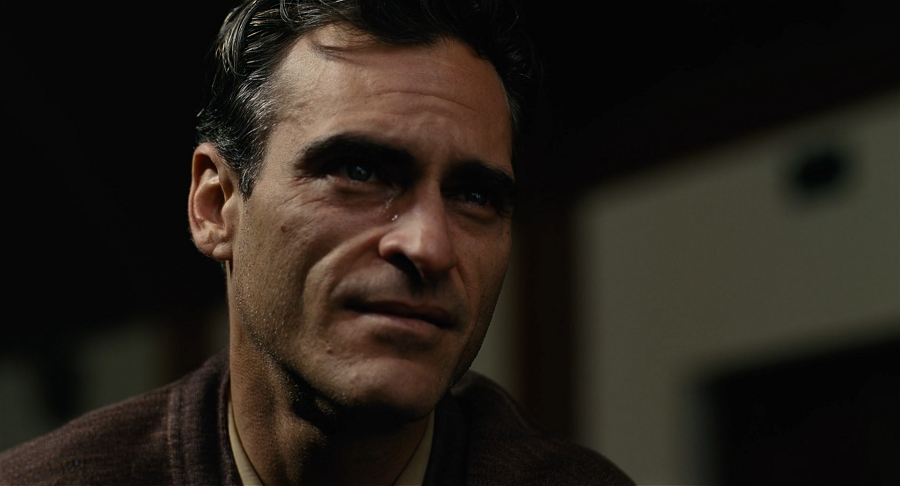
It was tempting to tie The Master's two main performances together for second place, so symbiotic are their contrary energies and styles. But Phoenix's borderline avant-garde lead turn ultimately gained the edge; through sex-addicted, PTSD-suffering drifter Freddie Quell, Phoenix gives a raw, constantly shifting shape to profound human impulses and uses it to illuminate them in strange and frightening new ways. Looking at the world with a constant snarl and eyes whose mocking stare just barely conceals his inner confusion, Freddie lumbers across the film like a lost Lon Chaney character in a semi-conscious quest for love and meaning, communicating mainly through grunts, snickers, sex and violence. The genius of Phoenix's performance lies in his ability to subtly convert these displays of prehistoric brutishness into poetic expressions of unexamined feelings, underlining the emotional and spiritual void they fill through minute alterations in tone and mood. Everything about Freddie's behaviour seems as primevally simple as can be, yet every one of Phoenix's choices makes his true nature more of an enigma - including the question of whether or not he even has one. No male actor this decade has given a more compelling, complete or challenging film performance.

1 - Isabelle Huppert as Michèle Leblanc in Elle (2016).
What Isabelle Huppert achieves in Elle is not only, as I described previously, the pinnacle of a unique career; it's the most detailed, complex and exhilarating work of characterization produced by any cinematic artist in the past ten years. Her performance never lets the viewer settle on a single settled opinion, forcing us to readjust our responses as she stealthily shifts across different emotions while keeping her cards close to her chest. Every glance, every gesture and intonation convey an inner battle of instincts, memories and desires, as if her body itself was the battleground of a war for sexual, societal and filial independence. Huppert's masterstroke is to keep these battles in plain sight for us to see so she can better engage with their emotional repercussions, letting them seep into our subconscious and grow as we react to her character's choices. Her performance, more than any other this decade, pushes the art of acting outside cultural comfort zones and into unexplored territories where our most complicated thoughts, feelings and behaviours take on a beautiful new form. It's the greatest work of film acting of the 2010s and one of the finest examples of the craft ever put to screen.

Wednesday, January 15, 2020

Another Decade - Part 1

Since gaining full-time employment, for which I am grateful beyond measure, I have had to confine my film writing to the occasional brief Twitter post, giving my immediate thoughts on a film I had just seen or briefly commenting on films I'd been thinking about. As is often the case with Twitter, the thoughts are brief, incomplete, jumbled and, for all intents and purposes, destined to be lost in an uninterrupted digital flow of disposable surplus brain activity.

Since we have arrived at the end of a decade - the decade during which my love and knowledge of cinema started taking full form - I nevertheless thought it fitting to belatedly join my peers and record my thoughts on the last ten years of film for posterity. To see an entire decade of human expression pass, after all, is always cause for celebration, reflection and wonder.

This has been a difficult decade indeed for the cinematic arts; as the banalization of digital techniques and equipment yielded new methods for visual exploration and access to stories that might otherwise have remained untold or told with insufficient firsthand knowledge, audiences have been steadily dividing themselves across mediums, politics and subcultures. For better and for worse, in this interconnected and globalized world, the act of watching films is no longer as homogeneous as it once appeared to be - but was it truly ever? The welcome growth of diversity among storytelling and critical voices now being heard in the western audiovisual landscape indicates no. From this, we may infer a clue as to one of the traits shared by this decade's best films: informed by the cultural, national, ethnic, political and social specificities of their creators and subjects, they shine a light on the remarkable disparateness of human experiences as would an individual mosaic piece. Taken together, they elevate our understanding of the feelings, impulses, desires and mysteries that unite us as a species - and the forces and circumstances that shape them each uniquely.

Without further ado, here goes my first list:

Best Films Of Each Year:

2010: Certified Copy

The passing of Abbas Kiarostami on July 4th of 2016 has left a void in human culture that can never be filled. At a time of rising nationalism and its consequent inter-ethnic and inter-religious tension, the unassuming power of his meditative humanism is all the more palpable in masterworks such as Through The Olive TreesTaste Of Cherry and The Report. In his first narrative fiction set and filmed entirely outside Iran in languages other than Persian, Kiarostami investigates the mysterious energies that animate human interactions through the making, unmaking and remaking of a newly-acquainted couple (British opera singer William Shimell and French acting titan Juliette Binoche) whose personal histories, beliefs and fantasies gradually intertwine to the point of reshaping their very identities.

Kiarostami's greatest quality as a filmmaker was always his patience. As an attentive observer of the passage of time and the people that change or resist change within its flow, he put viewers face-to-face with their own changing feelings through the experiences of people - both characters and actors - whose every interaction with another person forces them to readjust their knowledge of themselves and, in more extreme cases, makes them reckon with their own mortality. Transported away from the poetic verité neo-realism that forged his most familiar work, Kiarostami's art finds within the codes of European romance an ideal frame to express itself in new and innovative ways.

Revisiting Roberto Rossellini's Journey To Italy in its setting and themes, Certified Copy turns modern European intellectual discourse over art and authenticity into a framework in which the protagonists' own ideas about who they are, what they want and their relationship to each other get called into question, re-imagined and reified in a series of conversations whose true subject is in constant modulation. Kiarostami's direction of Binoche and Shimell is a wonder to behold; like a semi-improvisational orchestra, their combined efforts reach a level of artistry that transfigures cultural and temporal barriers into points of origin for a new path forward. It's as fitting a tribute from one neo-realist master to another as could possibly exist, and an exemplary demonstration of cinema's ability to open new avenues of thought.

2011: Melancholia

Lars Von Trier has tested the limits of art-as-therapy with more extreme disregard for audiences' tolerance than perhaps any other male filmmaker of the past 20 years save Caveh Zahedi. His off-screen behaviour, from juvenile jokes about being a Nazi to allegations of sexual harassment on the set of Dancer In The Dark levelled by Björk, has made it increasingly difficult to defend his on-screen output, particularly as recent films like Antichrist and Nymphomaniac, Vol. II play more like cinematic extensions of his edgelord misogyny rather than the critical self-evaluations thereof they pertained to be.

Melancholia would still be an outstanding work of art even without these points of comparison, but its honest lack of self-pity or excuses single it out not only among Von Trier's œuvre but among the totality of recorded human expression of the 21st century so far. Juxtaposing the gradual psychological fragmentation of a depressive bride's family unit with the incoming destruction of Earth by a rogue planet, Von Trier composes an apocalyptic opera that is both grand and intimate, as spiritually nihilistic as it is humanly empathetic. 


Through career-best central performances from Kirsten Dunst and Charlotte Gainsbourg, he gives voice to his existential pain and conflicted relationship with his human brethren with a sincerity unencumbered by the cynicism or learned melodrama he had previously deployed as narrative self-defence mechanisms. As achingly acute in its portrayal of depression as in its observations of familial cruelty, Melancholia nonetheless reveals itself, through the prism of its outlook, as a bittersweet ode to human existence whose poignancy remains uniquely affecting to this day.


2012: The Master

Of all modern American filmmaking auteurs, Paul Thomas Anderson is the most difficult to pin down. In the course of eight narrative features, his modus operandi has been consistent: take established genres, replicate the style and plots of instantly-identifiable cinematic masters who modernized them, and infuse them with narratives about lonely, broken people seeking or fleeing from connection - usually with a father or son figure - and validation. Yet within each story subsists an underlying conversation with its spiritual forebears that continues across each film, each instalment providing meaning that builds upon and complicates its predecessor.

The Master is in that respect the most exemplary of Anderson's films: even more obliquely plotted and dialogued than There Will Be Blood, it continues the 2007 masterpiece's dissection of masculine power struggles between the spiritual and the carnal - this time substituting the influence of John Huston's epic myths of greed with Stanley Kubrick's clinical Steadicam studies of the "ignoble savage" that is Man. On one side, sex-addicted drifter Freddie Quell - played beyond all superlatives by Joaquin Phoenix as a being of pure instinct, moulded by primal needs he barely seems to understand. On the other side, the irreplaceable Philip Seymour Hoffman's charismatic cult leader Lancaster Dodd - a man so used to suppressing his own needs that they manifest as spluttering explosions of rage whenever anyone dares to prod at the haphazard set of pseudo-mystical abstrusities he created as a substitute.

The duet/duel between Phoenix and Hoffman - one of the great acting miracles of modern cinema - serves the centre-piece of a dissonant symphony that never lets the viewer settle on a single emotional or intellectual response, putting them in a state of uneasy wandering reflective of the characters' relationships (and reflected in Jonny Greenwood's masterfully atonal score). Thus does The Master confirm the evolution of Paul Thomas Anderson's art: anchored in American cinema's aesthetic history but now emancipated from its codes and structures, it takes flight to uncharted galaxies of feeling whose every exploration yields only more territory to discover.

2013: Camille Claudel 1915

No filmmaker's art evolved in the 2010s to such boundary-expanding degrees quite like Bruno Dumont's. Renowned for his austere Bressonian tableaux contrasting humanity's moral and physical lows with its spiritual highs, the French Master of Misery had up until then made a point of casting non-professional locals in stories whose indomitable bleakness made their precious few rays of light shine all the brighter.

Camille Claudel 1915 marked a decisive turn in Dumont's body of work from which he has never since looked back; a portrait of a few days in the life of sculptor Camille Claudel three years into her forced institutionalization, the film stars Dumont's first professional actor - and what an actor! - Juliette Binoche in the title role, surrounded by real-life patients and doctors of the Avignon Montfavet Hospital Center playing themselves in an early 20th-century context. This genius casting decision creates a sense of innate anatopism around Binoche's presence that generates a transcendental empathy for both her and her co-stars, as each interaction strips away the medium's layers of artifice to expose each other's humanity with miraculous power. Each prolonged still shot of Claudel's face or one of her tormentors', each pan following her fellow patients' movements and gestures, act like communicating vessels filling each other with hitherto unseen meaning.

What Dumont achieves here goes beyond a mere spectacle of martyrdom; as he has always done and continues to do now with the anachronistic rock opera of Jeannette: The Childhood Of Joan Of Arc and the surreal comedy of Coincoin And The Extra-Humans, he turns the marginalized, the non-normative and the banal into magnified mirrors of our own personhood, exposing us to different ways of seeing and being. In Camille Claudel 1915's tragic subject, we find one of the most revealing and graceful mirrors ever offered to an audience - and arguably the greatest performance of Juliette Binoche's illustrious career.

2014: Under The Skin

In my original review of Jonathan Glazer's minimalist science-fiction masterpiece, I called it a "bold and beautiful look" at humankind through an alien gaze, an exploration of Otherness that would be worthy of Nicolas Roeg's Walkabout were it not for a slasher-movie ending I judged to be unimaginative and disappointing. While I believe all the other points I made still hold up, I wish to recant that last one; Under The Skin's ending is not only good, it's probably the only ending that could have taken the film's ideas and themes to a logical conclusion.

Indeed, revisited in the context of today's post-Weinstein era, Under The Skin's clinical dissection of desire, gendered bodies and body autonomy feels almost radical. As Dumont did with Camille Claudel 1915, Glazer dips one of cinema's most recognizable female faces in a sea of near-total strangers and forces us to wrestle with our preconceived perceptions of her and how we relate to her as a fellow human. And the results - unsurprisingly, necessarily - make us deeply uncomfortable.

Scarlett Johansson's unnamed alien's experience of her (their? its?) body frightens and disquiets as much as it intrigues and entrances. The world seen through her alert, curious eyes is like a fairy tale moodscape where princes and big bad wolves can seamlessly switch roles and where her own existence is a tragically unassimilable anomaly. Through her journey of self-discovery, Glazer paints one of the bleakest, strangest and most thought-provoking pictures of personhood - and womanhood - yet committed to film.

2015: Songs My Brothers Taught Me

Chloé Zhao is the best filmmaker of her generation. I realize such grand pronouncements are so commonplace in media parlance as to be rendered meaningless, but I feel as much confidence in this one as saying water is wet. No other director under 40 has given life to human emotions and dreams with as much unpretentious truth or intelligent sensitivity, and all these qualities are plain to see in this quietly earth-shaking first feature.

Songs My Brothers Told Me, which my original review described as "bucolic neorealism", stars Lakota inhabitants of the Pine Ridge reserve as dramatized versions of themselves as they struggle with self-definition through connections to their traditions, to outsiders or to each other. This struggle is given spiritual, physical and human profundity by impeccably natural lead performances from Jashaun St. John and John Reddy as a brother and sister duo whose differing relationship with their roots shapes the eventual paths they take.

Zhao films these conflicts with such respectful distance, such intuitive understanding of the characters' relationship with their environment and such trust in both her performers and audience that the very act of watching her film feels sacred. Like most great art, it draws your attention to facets of human existence that were always under your nose and reveals them in such a way that your perceptions are permanently changed for the better. 2015 was a year rich in powerful feature-length débuts, from László Nemes's Son Of Saul to Desiree Akhavan's Appropriate Behavior, but Songs My Brothers Taught Me stands proudly above them as one of the undisputedly best films of the decade.

2016: Elle

There is no actor alive more fearless than Isabelle Huppert. From the moment she first turned heads as a rebellious teenage girl in the final scenes of Bernard Blier's Going Places in 1974, the Paris native has challenged, shocked and surprised audiences with subtle, multi-layered performances as complicated women like The Piano Teacher's Erika Kohut, The Lacemaker's Pomme or the titular Violette Nozière - women with nebulous inner lives, whose desires, words and actions often seem at odds with good taste, moral convention, logic or common sense yet are always bound by a cohesive discernible purpose.

Elle's Michèle Leblanc, then, can be seen as the character all of Huppert's previous creations were building up to; an independent video game developer haunted by the memory of her murderous father, engaged in a sexual game of cat-and-mouse with a man who may or may not have brutally raped her, determined to assert control over her life, body and feelings in her own way regardless of consequences. A character who resists the exterior factors that shape life at the risk of endangering herself socially, psychologically and physically.

Thanks to the surgical precision of Huppert's deadpan performance and Paul Verhoeven's Machiavellian direction, that resistance extends to audience interpretation; for all the revelations David Birke and Harold Manning's screenplay share with us about her past, for all the flashes of vulnerability Michèle grants us, she stubbornly defies characterisation and continually forces us to revisit our responses. This uneasily murky complexity is just one of many things that make Elle a creative pinnacle for both its lead actor and its director.


2017: Phantom Thread

Paul Thomas Anderson has always been a comic master. Punch-Drunk Love and Inherent Vice may be his only forays into overt comedy as of this writing, but even the sombre majesty of There Will Be Blood, The Master and Magnolia was buoyed by a sly satirical undercurrent that complicated our emotional responses to them. That satire has never been more clear or sophisticated than in Phantom Thread, which absorbs the very best of Alfred Hitchcock's glamorously objectifying aesthetics all the better to thoroughly dress down the very myth of tortured misogynistic male genius he embodies.

As filmed by Anderson, the emotionally abusive Pygmalionesque relationship between fashion designer Woodcock Reynolds (Daniel Day-Lewis in his supposedly final performance) and his new model Alma (the revelation that is Vicky Krieps) has the quality of a poisoned apple; the opulent splendour of the lighting, gowns and sets ensnare us even as the chiaroscuro lighting and shallow depth of field alert us to the trap. But what initially seems like poison soon reveals itself as precious, liberating comedy - comedy that shifts our perceptions of the characters' behaviour and enrich their humanity even as it highlights the situation's dark absurdity.

More than a deconstruction of artistic masculinity, Phantom Thread represents a culmination in its creator's lifelong study of the emotional yearnings and feelings of incompletion that so often drive the best - and worst - in human relationships. At a time when power dynamics in heterosexual relationships are under much-needed scrutiny, Paul Thomas Anderson's willingness to explore the needs and feelings behind them make his eighth feature as necessary as it is timeless.

2018: The Rider

Be it the scientific instrument it was initially conceived as, the popular entertainment it turned out to be or the art form it was subsequently theorised as, cinema's primary purpose has, with some exceptions, always remained the same: to observe and understand human life through the recording of movement. Of this decade's best films, Chloé Zhao's The Rider is the one that fulfils that purpose with the most purity, staying true to all three aforementioned primal conceptions of cinema as it chronicles the extraordinary ordinariness of one man's life.

The man in question is Brady Jandreau, or rather his on-screen alter ego Brady Blackburn, a Lakota cowboy whose promising rodeo career is brutally aborted by a head injury. Before Zhao's camera, this quiet and unassuming man becomes a cinematic subject of uncommonly powerful eloquence whose every glance, gesture and pace translates complex emotional states into common practical actions. All of his interactions with fellow humans, horses and nature, bound as they are by a common defiance of his conditions, expose an entire life's worth of discoveries taking shape for the very first time before our eyes.

Continuing Songs My Brothers Taught Me's dramatization of Pine Ridge Reservation denizens' aspirations, frustrations and relationship with their environment, Chloé Zhao finds in the careful observation of human and animal movement their most vivid and intimate expression. If movies are indeed, as Roger Ebert famously called them, "machines that generate empathy", then The Rider stands as one of the decade's most vital inventions for the myriad ways in which it enables a better understanding of a little-represented people and indeed the human race itself.

2019: The Irishman

Loneliness haunts Martin Scorsese's filmography as tenaciously as sin does. Whether you're a Vietnam veteran-turned-vigilante, a powerful Hollywood mogul, a Las Vegas mob boss or our Lord and Saviour Himself, to be a Scorsese protagonist is to live a life of moral and spiritual isolation with nothing but your own conscience for company.

The Irishman - or as its opening credits call it, The Irishman: I Heard You Paint Houses - embodies this loneliness as profoundly and as poignantly as the very best of the American master's work, inhabited as it is by an encroaching awareness of his own mortality. Not since Ingmar Bergman's Saraband has a film felt so intricately intertwined with its maker's specific place in time. Recent attempts to "correct" the film's much-discussed de-aging effects, however impressive, miss the point; the effects, like the masterful performances they ornate, are just another disguised mark of time - an omen of death as potent as the Xs in Howard Hawks' Scarface.

This morbidity, coupled with its many material and aesthetic connections to previous Scorsese crime epics, is what gives The Irishman its slow-burning emotional power. Composed like a bittersweet funerary dirge to its creator's career and the America he lived and shaped, it faces the future with the placid resignation of one who knows their time is nearing its end, embodied in one final, hauntingly beautiful shot that ranks among the most perfect to ever close a film. It is what it is.

Sunday, March 10, 2019

"Captain Marvel"


A full eleven years after Iron Man inaugurated a whole new era of superhero-dominated blockbuster filmmaking, Marvel Studios have finally released their first female-led film with Captain Marvel. Coming at a point where western feminism finds itself caught between mainstream cultural assimilation and widespread political backlash, the film bears the unenviable weight of having to both fulfil traditional fan expectations and live up to the feminist credentials implied by the very context of its existence.

In the latter regard, its 1995 setting cannot help but carry significance; four years after the Anita Hill hearings and two years before the Monica Lewinski scandal, the amnesic Carol Danvers (Brie Larson) crashes back in her native USA at a time where systemic sexism and power imbalances were kept buried under the façade of economic progress by triumphant pre-9/11 cultural neoliberalism. Her subsequent journey of self-discovery and empowerment doesn’t just echo many women’s individual feminist awakening, it also mirrors our culture’s loss of innocence – and the course correction subsequently undertaken in response.

That journey’s thematic stakes are made clear in the film’s opening sequence when Kree mentor Yon-Rogg (a yellow-eyed, teeth-gritting Jude Law) exhorts Carol (aka “Vers”) to control the mysterious photon energy powers within her by suppressing her emotions. It’s a familiar character arc setup, whose eventual subversion showcases the centrepiece of the film’s feminism: a rebuttal of traditionally masculine notions of power through control and dominance in favour of embracing one’s emotions, expressed in a context where doing so grants the female protagonist an inherent advantage

By astutely constructing 90s Girl Power fantasy as a response to current patriarchal manifestations (exemplified by an obnoxious biker’s remark that Carol should “smile more”) and echoes of complex real-world injustices, directors and co-screenwriters Anna Boden and Ryan Fleck effectively fuel millennial activism with nostalgia. They prove less adept, however, at overcoming the intellectual and aesthetic limitations imposed by the film’s commercial roots.

Consider the third act power-up, where Carol achieves self-actualization after reaching her lowest point, fuelled by male peer discouragement and past feelings of inadequacy. It’s a conceptually empowering, if fairly conventional beat, the impact of which is dampened by editing choices that make it look like a commercial using progressive visual language to promote corporate interests. Moments like these restrain the viewer’s imagination as well as the character’s evocative potential by replicating pre-existing feelings and ideas rather than conjure organic ones.

These creative lapses extend to the fight scenes, which Boden and Fleck mostly film in tightly-framed close quarter shots that cut up the actors’ bodies into digestible morsels of sound and impact instead of following complete movements. They don’t express action so much as punctuate it in such a manner that it registers in our minds without connecting to any emotion beyond pavlovian responses.

Still, the duo display sufficient visual imagination to make up for these lacunas, as demonstrated when Carol gets her mind probed by shape-shifting Skrull rebels and a fleeting memory of her interacting with the mysterious Dr. Lawson (Annette Bening) gets played again and again in an attempt to retrieve information. In takes digitally edited together to look like a continuous shot, Bening and Larson repeat the same dialogue from different angles and positions, each exchange conjuring a different emotion – familiarity, strangeness, pain – through the changes in shot scale as well as in the actors’ expressions.

The actors are indeed a huge factor in what makes the film ultimately work; if there’s one thing the Marvel Studios understands, it’s that superheroes have effectively replaced movie stars and that actor and character personas should thus be indistinguishable, which makes Brie Larson both ideal and atypical. As famous for her outspokenness as for her acting, she’s more everywoman than star, performing with a sensitive inwardness not usually associated with the wisecracking glamour of superheroics. Yet it’s precisely what makes her Carol Danvers work: she exudes a life-worn toughness that commands empathy more than awe, lending her character a socially conscious authority that matches her arc perfectly.

Her earnestness is beautifully supported by the grounded levity Samuel L. Jackson brings to Nick Fury. Always a slightly frustrating fixture in the MCU, Jackson’s role had until this point largely limited itself to looking cool and providing exposition and motivation. Here, he’s finally allowed to let loose and play Fury as a fully realized character, more nerd than badass, a vet-turned-office jockey thrown into a whole new world where he is both out of his depth yet strangely at home. His chemistry with Larson is complemented by the hitherto-underseen comic chops Ben Mendelsohn displays as Skrull antagonist Talos, whom he plays with a casual kind of Aussie charm that offsets the ground-teethed villainous hamminess we’ve come to be familiar with.

Captain Marvel’s adherence to Marvel formula restrains its creative possibilities but within those confines, it finds room to visualize enough ideas and emotions to make its viewing worthwhile. Less inventive than the Guardians Of The Galaxy movies, with which it shares side characters and a knowing soundtrack, it nonetheless knows, like James Gunn’s duology before it, how to mine nostalgia for modern relevance. And in an industry that too often relies on it as a crutch, that may be just good enough.

Tuesday, November 27, 2018

"The Party" (2017)


Sally Potter’s recent career trajectory has been quite interesting. Having spent the 1990s and 2000s exploring the varying ways with which personal and group identity affect perception (The Tango Lesson), societal status (Orlando, The Man Who Cried) and interpersonal relationships (Yes), she has since taken a more overtly political shift, using her characters’ multiplicity of lived experiences and points of view to critique the radical chic middle class she grew and blossomed in. After satirizing society of the spectacle values in the bold but ultimately shallow fashion mystery Rage and examining the deleterious effects of politics as escapism in the splendid coming-of-age drama Ginger & Rosa, her latest film continues its predecessor’s dissection of liberal hypocrisies.

Set entirely in a posh London apartment, The Party observes the disintegration of seven privileged elites’ marriages and lives as (presumably Labour) party apparatchik Janet (Kristin Scott Thomas) celebrates her access to power with husband Bill (Timothy Spall) and a select group of five friends: Caustic cynic April (Patricia Clarkson), her New Age healer of a soon-to-be-ex-partner Gottfried (Bruno Ganz), cocaine-addled stockbroker Tom (Cillian Murphy), women’s studies professor Martha (Cherry Jones) and her pregnant wife Jinny (Emily Mortimer). The announcement of unpleasant news regarding Bill’s health starts a chain-reaction of revelations and developments that confront these people’s moral and philosophical convictions to the reality of human nature.

As in Blake Edwards’ similarly-titled Hollywood satire, Potter uses the uninvited guest (in this case, Bill’s illness) as the disruptor of established order, exposing behaviours, codes and motivations to scrutiny. What separates Potter’s film from Edwards’ and other similarly-structured plays and films is the direct link she draws between her characters’ egoism and the politics that form the foundation of their lives; guest or host, every guilty party’s outburst is sparked by the pressure their political narcissism exerts on their lives.

The resulting tension between the personal and the political is what infuses the dialogue with its incisiveness; Martha’s justification for allowing a friend to use her apartment for extra-marital trysts (“I thought it better than in your house”) is only slightly funnier than the wronged party’s self-aggrandizing claims of “saving our country from profiteering butchery”. Professional capitalist Tom’s raw-nerved emotionality is informed by a common-man conservatism provides a magnificent foil to both Gottfried’s maddeningly calm pseudo-philosophical platitudes and Bill’s neoliberal bourgeois smugness (“Money bought this house, not fucking ideas!” he retorts to the latter’s intellectual penis-waving). In one of the film’s more bittersweetly funny moments, April piercingly summarizes generational feminist rifts by gently reminding a betrayed Janet that “sisterhood is a very ageing concept.”

Potter, of course, is not critiquing beliefs themselves so much as examining what happens when we demand our politics define our relations to one another and dictate our conduct. No matter how cruel, selfish or arrogant her characters may behave, her style evidences her innate sympathy for them; note how the soft black-and-white cinematography and light-handed camera movements with which she films this verbal internecion resembles 1960s independent cinema. In doing so, she effectively casts the characters’ failings in the ambience in which the ideals behind them were conceived, lending an underlying nostalgic poignancy to every cut and blow they exchange. It’s a subtle touch that exemplifies Potter’s knack for visualizing her protagonists’ feelings through light, colour and shadow.

Running at a grand total of 71 minutes, The Party is a brisk and pleasant watch but no less sharp or fulfilling for it. Without quite reaching the profundity of Ettore Scola’s similarly-themed epic We All Loved Each Other So Much, Potter nevertheless dissects Britain’s ruling political class with the knowing accuracy only a fellow member could achieve.

Saturday, November 24, 2018

"Widows"


“Never thought I’d marry a white man – or a criminal”. So bitterly ponders Veronica Rawlings (Viola Davis) as she remembers her late husband Harry (Liam Neeson), whose violent death alongside his comrades in a botched robbery of crime lord Jamal Manning (Brian Tyree Henry) has exploded the comfortable boundaries her social status once guaranteed. It’s a line that neatly summarizes the film’s themes and perspective thereon, an implicit acknowledgement of whiteness’s symbolic social power that dares to connect it to organized crime’s aspirational role in American cultural history.


Transposing Lynda LaPlante’s 1983 BBC miniseries of the same name to a 2008 Chicago on the verge of the election of one of its most illustrious sons, Steve Rodney McQueen’s Widows turns Veronica’s predicament and consequent leadership of an unlikely all-female gang of robbers into a metaphor for today’s intersecting identity politics. As she enlists working and lower-middle-class fellow widows Alice (Elisabeth Debicki) and Linda (Michelle Rodriguez) to do her bidding, her quest for personal liberation becomes a symbolic reparative crusade against white patriarchy that lays bare previously unexamined privileges she once enjoyed.

Consider her first meeting with the other women at a spa, and the business-like coldness with which she hands them money as if it were a toolset: her pacing is brusque, her expression stony, the imperiousness of her tone somehow amplified by the unmistakeable fear beneath it. Her tough businesswoman persona isn’t an act so much as a defence mechanism triggered by the social past these women reflect back at her. As Jamal Manning himself puts it to her so succinctly: “You’re nothing now. Welcome home.”

These class dynamics power the women’s interactions with a tension that quickly bleeds into peripheral plots surrounding alderman Jack Mulligan’s (Colin Farrell) reluctant efforts to maintain his family’s power in a predominantly black ward and Alice’s sugar-daddy arrangement with a dollar-store Christian Grey (Lukas Haas), to the point of achieving a kind of poetic rhythm as scenes and dialogue echo and build upon each other: when Veronica repeats Manning’s earlier putdown in a rare display of vulnerability after a physical altercation with Alice, their relationship progresses into a newfound solidarity bolstered by inter-class understanding; when Mulligan’s racist father (Robert Duvall) reminds his son their only purpose and duty as politicians is survival, his words evoke a dark reflection of Veronica with the added subtext of racial anxiety.

These touches give Widows a sly playfulness that McQueen’s filmography noticeably lacked until now. Approaching his political subjects with an art student’s eye for corporeality and texture, his previous films studied their pain and physical destruction to occasionally excessive degrees (Shame) but Widows opts to humanize its characters through pointed behavioural details rather than debasement. In doing so, he evidences a hitherto unsuspected talent for black comedy and political humour, best exemplified in a gun show scene during which Alice appeals to a female customer’s class guilt and white female solidarity by pretending to be an impoverished Russian illegal immigrant fleeing abuse (“You’ve always said a gun is a girl’s best friend” her daughter pipes up in a scathing punchline).

It’s perhaps unsurprising that McQueen would show such a canny understanding of our current divisions, but the satirical accuracy with which he anticipates both the hope and painful divisions that would characterize the Obama era comes as an especially welcome contrast to his previous propensity for occasional self-seriousness. Using the fatal police shooting of the Rawlings’ son (in front of a wall plastered with Obama posters no less!) as an instigator to the disaggregation of their marriage and lives, McQueen metaphorizes the 2008 election as an exposure of white patriarchal hegemony’s inherent, destructive fragility.

This is where McQueen’s visual artistry comes into play; from the opening shot of Harry’s playful pre-coital roar match-cutting into the gunfire of his fatal robbery, he visualizes a connection between virile masculine performance and toxic violence with an almost comic book-like panache that expresses his character’s mindset without versing into outright caricature. In a new twist on his familiar long-take conversations, he films Mulligan venting his white masculine anxieties (“have you ever slept with a black guy?”) to his campaign manager (Molly Kunz) from the car hood, both protagonists out of sight, as the camera films the housing projects he’s inherited for half the journey before slowly turning to the right to show his own affluent neighbourhood just as his manager urges him to man up. It’s a highly evocative, undercover journalism-inspired sequence that neatly distils the film’s themes of social determinism, neoliberal hypocrisy and patriarchal fears with a formal elegance and stylistic intelligence many modern such takes sorely lack.

These audiovisual highlighting of individual expressions and the politics that inform them make Widows feel alive in every frame, accentuated by McQueen’s use of reflections and motivated camera moves to express his characters’ fractured identities and teleguided social trajectories. None of that life, however, would come to be without the actors’ superb work: always a magnetic presence even in mediocre material, Viola Davis’s ability to convey an intricate network of feelings with the smallest shifts reaches a pinnacle untouched since Antwone Fisher. There’s a scene early in the film where Veronica talks to her driver (Garrett Hedlund) who offers to leave her employment due to her inability to keep affording his services. Look at Davis’s face; her face is a mask of sincere gratitude and sadness, yet there’s also a spark of grim inspiration behind them as she finds a solution that could help them both – at great potential cost to him. Not many actors can convey so much with so little.

Davis’s commanding performance is superbly complemented by her partners-in-crime – Elizabeth Debicki in particular stands out as an abused woman taking gradual ownership of herself – but it’s the small roles that make Widows’ denizens feel truly lived in. Be it Robert Duvall’s resentful patriarch struggling for what little power he has left, Adepero Oduye’s complex embodiment of capitalist identity politics (“I am an empowered female minority business owner!”) or Jon Bernthal’s chillingly casual abuser, every bit part is like a snapshot of a fully-lived life, isolating feelings and experiences in a precise here and now that better enhance their greater social relevance.

Widows is not without its flaws; the screenplay, credited to Steve Rodney McQueen and Gone Girl’s Gillian Flynn, wraps subplots around each other in a way that occasionally suffocates individual characters (such as Jacki Weaver’s abusive mother and Brian Tyree Henry’s Jamal Manning, whose motivations are only explored on a surface level) and stunt certain plot developments. Still, McQueen’s perfect attunement to his characters’ emotions and movement coupled with his and Flynn’s political acumen make this socially perceptive thriller one of this year’s essential viewings.

Sunday, November 4, 2018

"Bohemian Rhapsody"


Who was Freddie Mercury? To the general public, he was a larger-than-life rock icon, a pioneering musical genius whose sexually fluid showmanship transcended boundaries and set a standard of showmanship never since surpassed. To those who knew him, he was a man of many contradictions, as shy as he was extravagant, as selfish as he was kind, a flamboyant figure whose hedonistic excesses were matched by his coyness regarding his private life.

All biopics, to one degree or another, have to answer such a question but the unique sociocultural complexities of Freddie Mercury’s identity make it particularly essential to Bohemian Rhapsody’s central thesis. He was a queer Parsi immigrant who resisted any such categorization as strongly as his music did; how did his relationship with his own identity affect his art? How did his music, in turn, express the truth of who he was – if at all?

Bohemian Rhapsody tentatively touches on these questions but fails to probe them beyond a surface level. Instead, it moves through his life as if it were a series of questions on an exam sheet, each answer technically correct but unedifying and uninformative beyond the simple assertion of facts and summaries.

Early scenes of Mercury’s life with his family show him at odds with his tradition-minded father (“good words, good deeds, good thoughts”) who disapprovingly notes his adoption of “Freddie” as an anglicized alternative to his birth name Farrokh, implying a rejection of his heritage. This accusation of assimilation is reflected in the third act when a jilted ex-manager (and ex-lover) disparages him as remaining at heart a “scared P*** boy” – also echoing a loutish audience member’s racial slur during the band’s first performance. Mercury’s own feelings about his ethnic identity, cultural heritage and sense of belonging, however, remain elusive; twice he voices his vision of Queen as belonging to those who don’t belong anywhere, but the screenplay seems curiously uninterested in digging any deeper. In lieu of conflict, we simply get a half familiar all-too-quickly-resolved arc of a queer man coming out to his conservative father and finally earning his approval.

The clearest indications about Freddie Mercury’s inner struggles come from conversations with his long-suffering ex-girlfriend Mary Austin (Lucy Boynton) during which they talk about the adulation of the crowd. They frame his excessive partying, poor choice in friends as manifestations of a need for love and validation directly connected with struggles over his sexuality and self-presentation. Mercury’s life, the film suggests, was defined by an ongoing quest to be his own person and to figure out who that person was. That’s not a bad perspective to take but it requires a certain willingness to take risks in cutting through Freddie’s self-image and examining his insecurities – risks that director Bryan Singer is unwilling to take.

As a band, Queen were bold, innovative and risqué. They blurred lines between genres, experimented throughout their career while remaining distinctly mainstream, and exuded – largely through Freddie’s songs and stage performances – a titillating sexual energy that was naughty, playful and brash but never crude. A director truly in touch with that energy would have connected it to Freddie’s unapologetic individuality and used it to illuminate the secret feelings that animated it but Singer instead plays things disappointingly safe, mainly using Queen’s music as bland illustrations of selected “making-of” scenes that tell us very little about how these songs actually came about or what drove them. Freddie’s passion for music and art are only glanced at, taken for granted as if they sprang ready-made from his mouth. Even his famously lavish, drug-fuelled parties are a shockingly tame affair, devoid of any danger or sensuousness, as if someone had recut The Wolf Of Wall Street for pensioners.

Only intermittently does the film match its subject’s personality, in montages where Queen’s music comes to life in voicing the nuances of Freddie’s sexuality (ironically, with two songs he didn’t write). One sees a performances of “Another One Bites The Dust” interspersed with Freddie being guided by Svengali-esque manager/lover Paul Prenter (Allen Leech) into the gay leather sex club Mineshaft, culminating in a frontal shot of him entering a dark room at the top before a cut to black segues into a press conference during which he starts exhibiting HIV symptoms. Strongly reminiscent of Cruising, this sequence is as evocative as it is problematic in its tonal implications, using the song’s unmistakeable beat to strong erotic effect while also questioning the feelings behind Mercury’s iconic sexual expression. Another cheeky flourish involves Freddie talking to Mary on a payphone as a trucker invitingly walks in a men’s restroom as “Fat Bottomed Girls” climaxes to the lyric “Get on your bikes and ride!”. While arguably misrepresentative, these montages nevertheless show a flair and musical understanding that’s missing from the rest of the film, probably attributable to late-stage replacement Dexter Fletcher.

That a mediocrity like Singer ended up helming a biopic about one of pop music’s great geniuses would only be shocking if the surviving band members’ understandable protectiveness of Mercury’s legacy wasn’t common knowledge. The choice to use the 1985 Live Aid concert, widely seen as the band’s finest live performance and the moment that propelled them back to the top after a brief dip, is quite revealing in that respect: It allows screenwriters Anthony McCarten (already responsible for the equally over-reverent The Theory Of Everything and Darkest Hour) and Peter Morgan to evacuate any of the real pain that might come with dealing with Mercury’s flaws or his struggle with AIDS and instead package his experience into a ready-made, one-size-fits-all tale of redemption and triumph.

This lack of honesty makes the task of Mr. Robot’s Rami Malek all the more unenviable, and his success in doing so feels almost miraculous. While he lacks some of Mercury’s swagger, he underlines his vulnerability and sense of displacement with a subtle precision that lends his scenes insight that’s often missing from the dialogue. His best moments involve small tonal shifts in his voice and body movements that clues us in on the fear beneath Freddie’s exterior cockiness, whether he’s criticizing his bandmates or phoning Mary with a glass of champagne to combat loneliness. Moments such as those hint at the film Bohemian Rhapsody could have been were it more interested in taking a closer look at Freddie’s inner life than in hitting biographical checkpoints.

It was perhaps a fool’s errand to expect any Hollywood film to shine light on the complexities of Freddie Mercury’s life, art and identity, particularly at a time when things are more commodified than they ever were before, but his genius deserved much better than the audiovisual equivalent of an authorized biography. Neither real life nor fantasy, this Bohemian Rhapsody remains resolutely stuck far too safely in the middle, too afraid of harming its subject’s image to illuminate it in any significant way.

Sunday, October 14, 2018

"Carnival Of Souls"


One evening in 1962, director Herk Harvey was driving past Salt Lake when he spotted an abandoned amusement park by the beach. It was a most unusual-looking pavilion, almost Eastern-looking in design, with big round domes and a long pier stretching out towards the horizon. The sight, especially striking at sunset, struck Harvey as “the weirdest looking-place [he’d] ever seen” and after a short walk inside, the man knew he had found a perfect location for a horror film. Once home, he called writer John Clifford and asked him to write a script that would revolve around the building.

The place was an old Mormon resort named Saltair, and the film that would subsequently immortalize it was Carnival Of Souls.

At first glance, Carnival Of Souls looks and sounds little different from the dime-a-dozen black-and-white B-movies that would usually play after the main feature: Unknown actors, small-town setting, visibly dubbed dialogue in exterior scenes… Indeed, the opening drag race scene initially looks like it could have been lifted from one of the many Wild One knock-offs that populated drive-ins in the 50s and 60s. But as the race goes on, the film’s identity slowly takes shape in conjunction with that of its protagonist Mary (Candace Hilligoss), a quiet, pensive-looking blonde, initially indistinguishable from the other two members of her girlfriend trio until close-ups of her worried, uneasy face start drawing the contours of a personality. By the time she has emerged from the river, a lone figure covered in sand, she appears to us fully-formed, seemingly reborn from the crash, framed in both the revealing frontal rise and the wider reverse-shot as a periurban Venus.

From this point on, Mary is identified apart from her surroundings – apart from her fellow victims, none of whom are mentioned again, and apart from a physical world which will incessantly crush, dominate and erase her until her identity is no more. The entirety of her ensuing journey to Utah as a newly-hired church organist is a continuous battle for her existence, autonomy and integrity – not only against the strange invasive foreign bodies only she can see but also the plurality of the people she meets.

And so Harvey instils within us a growing sense of unease by consistently underlining the alien-ness of Mary’s environment as well as her own disharmony with her fellow humans. Observe the shots of her life after the crash as an organist inside a factory (!), see how the pipes closer her in and fragment the frame into a mosaic. Pay attention to the positioning of her arms, the vacant expression in her eyes and the way her body slightly twists and bends as she plays, like an articulated porcelain doll. And note how the low-angle reaction shot of workers listening curiously to her music echoes an earlier shot of pedestrians on the bridge witnessing her rebirth. Now that she has gained an identity of her own, Mary is a curiosity, subject to the oppressive gaze and invasive bodies of others. Even seemingly ordinary interactions with other people – bosses, landladies, doctors – are tinged with unease; her rapport with male characters in particular is consistently defined by their attempts to control her. Some examples are obvious, such as the doctor’s paternalistic treatment of her fears or her creepy neighbour’s persistent disregard for her personal space or expressions of sexual disinterest. Others are more insidious, subtly emphasized by Harvey’s framing, composition and shot length; it’s in the stillness of Mary’s torso as her old boss touches her shoulder from behind and advises her to “put her soul” into her church work instead of seeing it as just another job, or the ever-so-slightly uncomfortable close-up of the minister’s expectant face as he assesses his candidate’s job performance before beaming with satisfaction. It’s in the way Harvey holds the camera on the church cleaning lady’s gaze for an unnaturally long time as she listens to Mary playing outside the frame.

Throughout the film, Mary is in constant conflict with the people and society around her, pressured to assimilate and conform, be it by worshipping at the church she works, accepting men’s advances or simply seeking out the company of others. Ever since rising from the scene of her accident and not acting like the traumatized victim everyone expects her to be, she has marked herself out to be corrected or – as she first experiences traumatically in a shopping centre – annihilated altogether. In that respect, her interactions with her neighbour are surprisingly profound: Initially coolly resistant to his sexual harassment, she becomes more tolerant of his presence and flirtations following a night of terror while nevertheless establishing clear boundaries that he continually dismisses. As her dissociation with reality grows stronger, she chooses to attach herself further to him, right until her panicked reaction to the apparitions around her scare him away. Not only is this a stunningly eloquent dramatization of how we shape our very existence and identity through the gaze and approval of the other, it’s also a relationship anyone knowledgeable about survival mechanisms in especially patriarchal environments will recognize with grim familiarity.

None of this, of course, means Carnival Of Souls should be seen as a feminist film but it adds further texture to Mary’s nightmarish experiences by implicitly connecting them with her stubborn individuality, to the point where the final plot twist – which I shall not reveal – feels more allegorical than literal. The horror derives less from the ghoulish apparitions stalking Mary than from the growing sense of dissociation Herk Harvey creates before unleashing them on his heroine’s psyche. Closer in style to the French New Wave experiments of Alain Resnais than the splattery schlock of William Castle, it signifies Mary’s spatial and temporal disconnection through ingenious match-cuts and Gene Moore’s eerie funerary organ score, which subconsciously links her chosen vocation to her ghostly stalkers and the world they entice her to. This is especially well-illustrated in a remarkable nocturnal driving scene during which Mary unsuccessfully tries to change radio channels when her upbeat jazzy tune is slowly replaced by Moore’s now-diegetic score. As the titular carnival, Saltair becomes a physical embodiment of Mary’s non-belonging, an expressionist beacon of unconscious intuition and dreams, dominating her with empty spaces that nevertheless feel more welcoming than the human world she endures more than lives in. By the time the “real” world has truly rejected her, its atemporal, spatially abstract darkness feels more concrete and somehow less hostile than the vast, populated world of indifferent humans outside.

Carnival Of Souls was the only feature film Herk Harvey ever made. The film passed without notice at the box-office and fell into the public domain, gaining a cult reputation only thanks to late-night television airings and subsequent festival screenings. Harvey, who had since returned to making educational shorts before retiring in the early 1980s, lived just long enough to see it justly recognized as the landmark in psychological horror that it is.