Tuesday, January 13, 2015

"Big Eyes"


Tim Burton’s new film has been noted by many as something of anomaly in his career. Not only is it his first film since Beetlejuice not to feature a single actor or actress he has worked with before, it also looks very different from the gothic expressionism of his most famous work. The pastel colour palette seen in Big Fish and Charlie And The Chocolate Factory is still present but in a subtly dimmed form, allowing Bruno Delbonnel’s magnificent lighting to imbue the shots with estival warmth. The same is true with the themes and forms Burton holds dear, and while it may not be one of his most accomplished films, Big Eyes still provides an unmistakably personal study of art and identity.

Considering how consistently he has championed the marginalized and defended kitsch, Burton’s interest in the true story of Margaret Keane (Amy Adams) – whose paintings of big-eyed waifs were appropriated by her tyrannical husband Walter (Christoph Waltz) and derided by art critics – is not surprising. What is both surprising and ultimately disappointing is the lack of empathy he and screenwriters Scott Alexander & Larry Karaszewski exhibit towards Walter Keane, a con artist who desperately wished to be real artist. You’d think the team whose Ed Wood made the world’s worst filmmaker a spokesman for the unparalleled joy of creation would at least understand Keane’s desire to experience that same joy and demonstrate compassion for his incapacity to experience it without justifying his wrongdoing. Briefly and insufficiently acknowledged, that frustrated drive is quickly used to turn Keane into a grimacing ogre who would be better-suited to Burton’s more expressionist ventures. Without a firm directorial hand holding him steady, the already questionable casting of Christoph Waltz as Walter turns into the film’s biggest problem; his over-exaggeration of conman smarminess is such that it becomes difficult to tell who of the actor or the character is seeking the most attention, and the film’s discourse on art and misogyny gets temporarily drowned out.

The latter part of that discourse, while neither the best-realized, is nonetheless something to take note of, as Burton’s cinematic universe has always thrived on 50s-60s nostalgia. To see him address one of the period’s less savoury aspects – its rigid gender roles and generalized casual sexism – is quite refreshing. Amy Adams’s performance alone serves as an accurate critique of both socially-constructed gender roles, women’s internalization of them and art’s affirmation of them. Her frightened, apprehensive eyes, unevenly assured demeanour and blonde hair evokes some of the “women in peril” from Hitchcock films of the time such as Grace Kelly in Dial M For Murder and Tippi Hedren in The Birds. It does a more effective job of conveying the internalized misogyny behind her lack of resistance than any dialogue about the need for money or a father for her daughter ever could. Feminists may raise an eyebrow or two at the film’s benevolent portrayal of the Jehovah’s Witnesses as the key to Margaret Keane’s independence and well-being, but it fits perfectly with Burton’s identification with outsiders, however conservative their own values might be.

“Art” says Terence Stamp’s steely-eyed art critic, “should elevate, not pander.” A highly significant line in light of the many criticisms levied towards Burton for his supposed pandering to fans. One could see Big Eyes as his own fairly nuanced response to that criticism, using Alexander and Karaszewski as willing conduits the same way Walter used Margaret as an unwilling puppet. Through this film, Burton argues that a work of art’s quality is not nearly as important as its sincerity, and that it in fact is impossible for art to even be qualified as such if it is not the product of the creator’s own ideas, desires and feelings. Therefore, as they did with Ed Wood but with less tact and incisiveness, Burton and his screenwriters maintain that the worst of a passionate creator is still worth more than a product tailor-made to suit popular appeal, no matter how slick it may appear.

"Horns"


There is a sore lack of proper appreciation for B-movies in contemporary film culture. At best, they’re enjoyed as mindless guilty pleasures, not to be taken seriously as pieces of filmmaking. As a fairly high-budget film that nonetheless possesses distinct B-influenced levity, Horns is unlikely to change that, but it may at least remind film lovers that style and substance often work as something of a ying-yang in which the strengths of one side  work to compensate for the deficiencies of the other. A typical pulp mystery at heart, Horns’s primary deficiencies stem from its lack of efforts to subvert the genre’s more overused tropes, particularly with regards to the rather sexist Madonna/whore binary in which it locks some of its female characters.

Indeed, among the many characters who confess their dirtiest (and almost always sex-related) secrets to bereaved murder suspect Ig (a very earnest Daniel Radcliffe, sporting a mostly convincing American accent) under the influence of his inexplicable new horns, most of the women are “whores” in either the figurative sense (a TV journalist ready to do anything for an exclusive interview and a vain waitress willing to lie and ruin lives just to become famous) or in the patriarchal sense (a mother having an affair with her golf teacher, a female friend and one-night-stand of Ig’s whose sexual promiscuity is treated with pity). The murder victim herself, Ig’s girlfriend Merrin (Juno Temple, whose subtle performance humanizes a theoretically one-dimensional role), is at the center of the plot not only as the main events’ catalyst but also as a figure whose interactions with peripheral characters suggest she may not have been all that she seemed. This could have been a good opportunity to break from the sexist binary and deconstruct the fantasized image of an innocent nubile nymph that director Alexandre Aja has given of Merrin in flashbacks – unfortunately, screenwriter Keith Bunin’s choice to stick with Joe Hill’s original twists means the third act reaffirms her status as an idealized tragic victim, whose behaviour was entirely dictated by her love for her man.

Thankfully, most of these shortfalls are redeemed by Aja’s acidic sense of humour and inspired stylistic choices. By infusing his rural noir setting with progressive rock sensibilities, Aja redirects both crime thriller and gothic fantasy clichés into an energetic and frequently funny cocktail of Miltonian symbolism and genre parody. The biblical allusions make no attempt to be subtle and the riffs on small town hypocrisy and media exploitation aren’t exactly new, but Aja combines and balances them with such deftness that they blend in together quite seamlessly, in such a way that it often feels like a concept album adapted without its songs. The third act is all the bigger a letdown for it, as it casts aside its impertinent wit in favour of an all-too-familiar pattern of resurgence, reconciliation, retribution and redemption. Still, Horns has enough zest and gusto for it to be recommended as a testament to the value of B-movie influences.

Sunday, January 11, 2015

"Transcendence"


If anything, Wally Pfister’s Transcendence serves concrete proof that good cinematographers don’t necessarily make good directors. Having shot seven of Christopher Nolan’s films, Pfister seems to think that he can turn first-time screenwriter Jack Paglen’s poorly thought-out cautionary tale of humanity vs. technology into his very own Inception. Indeed, aside from both featuring Morgan Freeman, Cillian Murphy and Lukas Haas, the two films could be seen as reflections of each other: Where one was about accessing man’s mind through a machine, the other is about man’s mind being transferred to a machine; where one had a grieving male protagonist whose deceased wife appeared to him as a dream imitation, the other has a female protagonist uncertain as to whether or not the figure before her is indeed her husband back from the dead or just an imitation. The film’s respective climaxes even share the same intercutting between the mending of personal wounds and the dramatic action scenes consequent to them.

Unfortunately, while Pfister’s shots are generally as impeccably composed as usual, the actors and actions within them are directed with the kind of laziness and lack of imagination one generally associates with direct-to-DVD action movies. It lays bare all the clichés in Paglen’s script – Pseudo-philosophical voiceover bookending the film, exposition delivered via conference speeches in front of a big screen and TV news reports, platitude-laden dialogue such as “you always fear what you don’t understand” (Hi Batman Begins!) – and with the exceptions of Rebecca Hall and Paul Bettany, leaves most of its talented cast directionless and stilted. Johnny Depp in particular, a truly great and uniquely expressive actor, looks like he’s sleepwalking his way through a very boring dream. It’s by far his worst performance since The Astronaut’s Wife.

What’s most infuriating about Transcendence isn’t the contrast between its intellectual vapidity and its self-serious tone so much as the sheer laziness with which it treats its ideas. This is a film where a depressed small town population that has allowed a computer-man to turn them into a network of drones he can access anytime he wants to heal their ailments or even resurrect them, thus improving their lives at the cost of their own personal independence and bodily integrity, is treated as just another plot point rather than individuals whose decision carries heavy contemporary political connotations and whose point of view deserves further exploration. A woman is forced to continue a relationship with a digital husband she cannot touch and whose true nature is in doubt, yet the best Paglen and Pfister can conjure from that situation is a brief dinner scene where her husband’s imitation of the sounds of cutlery and dinner plates unsettle her. Whether he realizes he and Paglen are dealing with philosophical and political topics beyond his grasp or believes the concepts alone are inherently profound, Wally Pfister never budges from the plot imperative and goes from scene to scene like a schoolboy writing down sentences from a half-remembered lesson. His only moments of grace come in the forms of semi-abstract long-focal shots of background details in motion, little moments that were small but significant elements that gave Inception a fittingly melancholic tone, but who appear in Transcendence like lost pictures from a different, better film. Impossibly outmatched by the themes it tries to raise and directed without vision or tact, Transcendence looks and feels exactly like it is: A pale, soulless imitation of a Christopher Nolan film.

Saturday, January 10, 2015

"Bad Words"


Jason Bateman’s directorial debut drives a richly promising premise down a rickety road before taking a more predictable turn and parking it in a ready-made plastic garage. Initially appearing to fully embrace the fact that Bateman’s antihero Guy Trilby – a bitter forty year-old man inspired by a mysterious past trauma to abuse a loophole that allows him to participate in a national spelling bee contest – is one of the most odious protagonists of the year, screenwriter Andrew Dodge makes the audience laugh in shock at his nasty and frequently bigoted insults before settling for a hackneyed been-there-done-that tale of the cold-hearted cynic who softens and finds redemption through the power of  friendship with a minority kid. In this case, the kid in question is 10 year-old Indian-American competitor Chaitanya (Rohan Chand), the kind of annoying child prodigy that only exists in freewheeling independent comedies attempting to ape Wes Anderson without truly understanding what makes his films work – as also exemplified by a “fun times” montage featuring slow-motion shots and upbeat Beastie Boys song, reminiscent of the “Me And Julio Down The Schoolyard” montage in The Royal Tenenbaums, ironically one of Anderson’s lesser films. The relationship itself ends up degenerating to a bitter conflict that brings to mind the comically serious romantic rivalry between Max Fischer and Herman Blume in Rushmore, but fails to get as much laughs due to its contrived nature.

Visually, Bateman’s film is bathed in soft beige-ish tones that originally provide a nice contrast with the harshness of Guy’s words and feelings, until they become a warrant for its facile backtracking into crowd-pleasing sentimentality. His direction’s simultaneous support of Guy and acknowledgement of his awfulness becomes problematic as the dirty deceits he uses to break challengers’ concentration – which range from convincing a boy that he slept with his mother to tricking a girl into thinking she’s having her first period – become increasingly cruel. It would have befitted Bateman to treat Guy with the same balance of brutal honesty and compassion with which Jason Reitman and Diablo Cody treated Mavis Gary in Young Adult, for his Freudian excuse to find emotional resonance. More damningly, by allowing the story to sidetrack into a corny “odd friendship between man and boy” story, Bad Words sidesteps a target offered by its premise on a golden platter: The typically American capitalist fascination with competition and triumph over adversity, something Hollywood has contributed to perhaps more than any other American institution. Since Bateman and Dodge are unable to fully engage the socio-political implications offered by their setup, Guy’s use of misogynistic, homophobic and racist jabs (he frequently addresses Chaitanya by the nickname “Slumdog” among other pleasantries) as a fig-leaf to hide his misery unintentionally parallels the filmmakers’ own use of would-be shock humour as a substitute rather than support for substance.

The only truly offensive aspect of the film is its prevalent misogyny: Aside from Philip Baker Hall’s snooty Dr. Bowman, the majority of the film’s killjoy figures, from Allison Janney’s dogged spelling director to Beth Grant’s unamused hotel clerk and Rachael Harris’s outraged mother, are all women. And when women are not actively opposing Guy’s antics and mocked by the filmmakers for doing so, they’re either means for the two male leads to bond (Guy’s idea of a rite of passage for Chaitanya is to pay a poor overweight black prostitute to show him her voluminous breasts) or to simultaneously advance the plot and provide a reward for the protagonist’s triumph and good behaviour (Kathryn Hahn, whose incredible performance in Afternoon Delight I raved about here, gets some laughs but ultimately little to do as a needy journalist following Guy around and whose trysts with him are hampered by her inability to orgasm while looking at him). These two particular examples of misogyny are less a fundamental element of the film than the consequences and illustration of Andrew Dodge falling prey to the same excessive triumphalism his screenplay tries to subvert; Guy may end up losing the bee contest but he still triumphs over his issues, humiliates his enemy and gains a friend and a love interest as a reward. The only difference between this film’s “moral victory” and the one that ended Rocky is that Rocky Balboa’s moral victory was the emotionally resonant culmination of very lifelike people’s feelings and desires.

Jason Bateman, usually accommodated to playing put-upon nice guys, elevates much of his material with an unapologetically harsh, in-your-face performance that suggests he may have understood that the humour of Guy’s character and situations is derived from an acknowledgement of his misery.  More’s the pity that the film’s screenplay, and his treatment of at least half of it, says otherwise.

Sunday, December 21, 2014

"Two Days, One Night"


How strange it is that a single human element can simultaneously be a film’s greatest strength and the source of most of its shortcomings. But such is the case with Marion Cotillard’s lead performance in the Jean-Pierre Dardenne & Luc Dardenne’s 9th feature-length film Two Days, One Night. Such a high-profile star casting decision rose more than a few eyebrows in the cinephile community, as the Dardenne Brothers had spent the quasi-totality of their filmography casting non-professional or unknown actors, of which three — Olivier Gourmet, Fabrizio Rongione and especially Jérémie Renier — subsequently rose to certain prominence. However, their previous 2011 effort The Kid With The Bike had starred Belgian actress Cécile De France, so one may see the decision to cast Cotillard as a logical step forward. Regardless, fears that such an international star would stick out like a sore thumb in the Dardennes’ restrained and neorealist-influenced portrayal of working-class Belgium have proven to be only partially justified: Against all expectations, Marion Cotillard delivers a startlingly unglamorous and unassuming performance without once giving the impression of making ostensible efforts to do so; an achievement all the more impressive considering the potential her role — a depressive mother and wife struggling to keep both her psychological composure and her job after a sick leave — had to be used as a vehicle for patent award-baiting. However, the star-struck reverence with which Dardenne Brothers film her suffering ends up handicapping the film by its consequent relegation of smaller but no-less important actors to the sidelines.

 
Much of the film consists of variations on the same scene: Sandra (Marion Cotillard) goes to visit a coworker, explains her predicament and the upcoming revote that will decide her future, and then asks them to give up their pay bonus in order to save her job. Much of her dialogue in each of these scenes is the same, with several details – such as the number of remaining votes needed – changing throughout. In the best of these scenes, Cotillard’s performance takes a backseat in favour of her coworker’s, allowing their characters to grow and feed each other harmoniously. An example: During Sandra’s explanation of her situation to a stone-faced Julien (Laurent Caron), the camera pans from a close shot framed around her neck and shoulders to a similar shot around Julien then briefly goes down towards his son as he sends him away, before moving back to frame both characters in the same shot, a position it holds until a defeated Sandra turns around and walks back to her car only for Julien to come back in the shot for a few more hard questions about whether or not her boss still needs her. The entire scene takes place in a single shot that conspicuously abandons its protagonist in an attempt to extract what little emotions might slip through the cracks of her coworker’s seemingly inflexible face. Taken out of context (almost the entire film is shot on handheld cameras), the process may call attention to itself but is quickly eluded by the weight of the actors’ words and the discreet, tranquil force of their barely-moving bodies. Aided by the almost amateurish basicness of its setup – two people in front of a brick wall, the stiffness of Caron’s body language and vocal delivery, far from hindering the film’s attempts at realism, marvelously complements Cotillard’s slightly hunched posture, her blemished, heavily-lidded eyes and their persistent habit of lowering whenever she looks at her interlocutor for more than a couple of seconds. It perfectly encapsulates the dilemma and resulting inner conflict Sandra has to deal with: She needs her salary to afford her house, but she knows full well that many of her coworkers have a similar dependence on their promised pay bonus. She needs help, yet she is afraid to seek it out of a mixture of pride, growing hopelessness and the knowledge that she is interfering in others’ lives and plans.

There are sadly many other scenes that do not succeed as well with that premise, and that is where the Dardennes’ usually impeccable actors’ direction becomes problematic. In scenes such as her meeting with Willy (Alain Eloy) or virtually every scene involving her husband Manu (Fabrizio Rongione), their camera is practically pasted to her and her control is rarely questioned, thus preventing a more thorough survey of any hidden feelings the scene may hold. An additional problem that tarnishes both the film and the Dardennes’ record is their uncharacteristically clumsy dialogue. Having apparently forgotten their knack for making the most banal and pedestrian words and phrases we use every day sound fresh and unpolished, the Brothers have peppered their script with heavy-handed emotional exposition that, far from the uncompromising simplicity of their greatest films such as L’Enfant or Rosetta, seems intent on taking the audience by the hand and telling them what to feel. This is evident from the very first scene, which sees Sandra waking up to a phone call, listening to the unheard bad news then walking to her bathroom to pop a pill and repeat to herself “I mustn’t cry…I mustn’t cry…”. The viewer does not yet know what has made her so upset, but the blatancy with which the scene attempts to grab their attention as well as its instruction on what to feel through dialogue that could come across as a form of reverse psychology, makes it a particularly clunky introduction. Part of this can be once again ascribed to the rapture that appears to have taken possession of the Dardenne Brothers as they follow Cotillard around the room struggling to maintain composure, as if to say “Look how amazing our actress is!” Which, it bears repeating, she is indeed. But as a general rule, a filmmaker should always keep the focus on the character rather than how good the character’s performer is.

 
It is a great shame that the Dardennes’ overreliance on their star performance prevents their film from reaching the heights they previously attained with just-as-truthful performances from good-but-not-quite-as-great actors. Theirs is a world of sound and sobriety, where the greatest bursts of beauty often come from the moments where their camera holds still for a while and allows all senses to converge as one. Such scenes are present in the film: the long close-up profile shot of an emotionally depleted Sandra in the front passenger seat of her car as her mobile phone rings insistently off-screen, goes silent and is subsequently replaced by Manu’s who picks it up; the masterfully-filmed suicide attempt scene, comprised of a very long medium shot from Sandra’s back with her face reflected in the bathroom mirror as she takes out all the Xanax tablets out of their plastic bars to swallow them. The sound team makes sure that every single rustle of plastic as the tablets come out of their containers is heard, that not a single gentle clank of them touching each other as she puts them in the cup is omitted, as the true nature of Sandra’s gesture slowly dawns on the horrified viewer.


If it has not supplanted The Son as the weakest film in the Dardenne Brothers’ filmography yet, Two Days, One Night is an arguably greater and more frustrating disappointment considering the amount of talent on display. After having achieved a certain kind of naturalist poetry with The Kid With The Bike, the Dardennes appear to have fallen back on a certain kind of formula based on a mishmash of their previous successes: Handheld cameras, a working-class setting, a sympathetic migrant worker or two, a couple of actors from the old guard (Rongione, and Olivier Gourmet, who has appeared in every Dardenne film since 1996’s The Promise) and an acclaimed female star in the leading role of a woman fighting for her fate. There is of course nothing inherently wrong with using familiar tropes, but comparison to previous films cannot help but induce the unpleasant sensation that the Dardenne Brothers might have run out of breath. Let us hope they will catch up soon.

Monday, December 8, 2014

"Obvious Child"


Worthy indeed is the goal that Gillian Robespierre’s Obvious Child sets itself on: To honestly tackle the subject of abortion from a female feminist perspective. Still a taboo subject in an allegedly progressive Obama-era America, abortion’s portrayal on film – in Hollywood or otherwise – is consequently rare. Indeed, aside from made-for-television-or-cable movies, abortion is very rarely made the centerpiece of American films. Whenever the subject is brought up in films such as Juno or Knocked Up, it is quickly evacuated with the same uncomfortable haste with which a show host might display in trying to get a particularly offensive comedian off the stage before the crowd gets too angry. Knocked Up, for all its candid portrayal of relationships and adult immaturities, was too afraid to even mention the word, preferring to instead say that it “rhymes with shmashmortion”. So desperately in need of authenticity in its cinematic depictions is this subject that Obvious Child’s ultimate inability to live up to its own objectives is rendered all the more disappointing.

From the opening credits, Donna Stern (Jenny Slate) is introduced to the audience as a human avatar of what the film aspires to be: A charismatic, abrasive stand-up comedian who derives her humour from demystifying the female body with scatological jokes about sex and bodily functions based on her own life experiences. Her best friend Nellie (Gaby Hoffman) even makes the point to spell out to her – and the viewer – that the greatest thing about her is that she is “unapologetically herself”. Almost every scene in the film’s first 15 minutes seems consciously designed to incite the audience to like and relate to the protagonist: After getting dumped by her cheating boyfriend, she spends the night getting comically drunk and attempting to call him only to get evicted from her flat the following day, forcing her to sleep at her father’s (Richard Kind); when she isn’t being told by her entourage what a brilliant and funny person she is, she’s being chastised for wasting that brilliance. As if to further make twentysomething Americans nod their heads in recognition, she also has to pay off student debts.

It is sufficiently annoying when mainstream films make visible efforts to forcefully obtain their audience’s support of their protagonist; when allegedly independent-minded films intended to provide more realistic and flawed characters soften their blows by embellishing these flaws as elements to be admired through laughter instead of accepted as they are, they demonstrate an unwillingness to take risks that severely impairs their aim.

Aside from the breakup-induced drinking that gets her pregnant during a one-night stand with Max (Jake Lacy, who looks like a slightly beefed-up Michael Cera), none of the aforementioned issues ultimately matter. Her financial problems are casually mentioned from time to time without getting any more relevant and her parents exist mostly to dispense life advice and comfort at dramatically convenient times. This is one of Obvious Child’s major failings: In its endeavor to subvert abortion clichés, it allows itself to wallow in romantic comedy clichés and ends up losing on both fronts: None of the characters ever break out of the prepackaged set of rules they’ve been assigned: The supportive female best friend, the mother who appears somewhat cold and out of touch but turns out to have more in common with her daughter than the latter suspected, the gay male best friend whose sex life and love life is discussed but never actually proven to exist… These characters have no true individual identity of their own and remain firmly inside their boxes. Nellie does tease the possibility of standing out among them when the topic of her own past abortion is brought up, but never goes through with it.

Indeed, the pinnacle of her characterization comes in the form of an indignant rant following the suggestion that Max might deserve to know about the situation. Asserting the priority of Donna’s needs over those of a man she barely knows, she callously refers to the soon-to-be-aborted fetus as “that fucking thing” and deplores the legislation of women’s vaginas by “a bunch of weird old white men in robes”1. She later reassures Donna that abortion doesn’t hurt apart from a few subsequent vaginal cramps similar to period cramps, and that’s as far as we’ll ever get to know her as a person. As for Max himself, Jake Lacy’s warm performance never manages to transcend his character’s bland predictability. His everyman persona presents opportunities for a broad range of emotions with regards to Donna’s awkward interactions with him, her secrets and the eventual revelation of her situation, but Robespierre squanders the most important of them. Max consistently remains an idealized Nice Guy™, whose acceptance of Donna’s pregnancy and plans for abortion is all the more remarkable in its unconvincingness considering she reveals it to him during a stand-up routine for all to hear – echoing the film’s opening, where her public jokes about her boyfriend’s penis and their sex life, all while he was in the audience, accelerated their break-up. Sure, his first reaction is to leave the room but he gets over it the very next day, just in time to accompany her to the abortion clinic where they can start their relationship on a new ground and get a hollow happy ending, obtained with far too much emotional ease and contrivances to be believable. Nobody really got hurt, nobody grew up organically.

This pattern repeats itself throughout the film: Supporting characters appear, a potentially uncomfortable situation is created only to be defused and quickly forgotten. One standout is David Cross’s appearance as a fellow comedian who invites Donna in his car just as Max was coming to see her in the club, setting up the detested bane of romantic comedies that is the third-act breakup. David Cross’s character shows a certain promise: A cynical comedian back from Los Angeles after selling his first pilot who, despite talking to Donna as he would a friend, still makes transparent attempts to seduce her – at one point accidentally-on-purpose spilling wine on his shirt then returning with a woman’s camisole that, combined with his rather full beard and hipster glasses, makes him look like a cross-dressing gay Bear. He makes passes at her in a joking tone that, rather than being creepy, hints at something theoretically interesting. His words and actions appear motivated less by genuine lust than by a desire to act upon a perceived lack of self-worth. Yet Robespierre steadfastly refuses to make the scene uncomfortable to watch, choosing instead to use comedy as a way to deflect pain and embarrassment rather than transcend it. Donna leaves and David Cross is never seen again. Drained of all its potential, the scene is reduced to little more than a time-filling plot contrivance.

Limited as it is by its reluctance to make the audience uncomfortable, the courage of Gillian Robespierre’s screenplay limits itself to making abortion its main subject matter, taking an openly pro-choice stance on it and including explicit jokes and discussions of women’s body parts and their functions. When it comes to more subtle and potentially more frightening areas of human behaviour and feelings, such as the process that led Donna to realize her own immaturity and inaptitude at child-rearing, Robespierre plays it disappointingly, depressingly safe. The conventionality of her writing is matched by her directorial choices: Jump-cut montages of Donna getting drunk or writing on a bench, postcard-shots of New York as a guitar plays trite indie music on the soundtrack, a color palette comprised almost exclusively of warm colors… Less evident but all the more damning is the poverty of Robespierre’s visual grammar: the majority of her shots are static and framed up to the characters’ waists or chests with the occasional wider, transitory shots. Lack of frame diversity isn’t necessarily in and of itself a huge problem in narrative film if the shots are composed, assembled and edited in such a way that there is always something aside from the general events going on both within them and between them. In Obvious Child’s case, the scenes are filmed and edited with a generic predictability that is completely at odds with both its subject and Robespierre’s intended treatment of it. Only Donna and Max’s reunion in the library stands out as an example of Robespierre exploring a visual element – Donna sitting in a cardboard box – to its visual potential. As a whole, the film looks and feels like a ready-made assembly line product with the Sundance stamp of approval on it. It serves as proof, along with such similarly unadventurous fare such as 50/50 and Robot & Frank, that much of the so-called “independent” American film industry is really just a lower-budgeted Hollywood with the same plastic ideas and emotions.

Thankfully, there are still remains of what the project could have looked like had it blossomed into the acidic flower of subversion it was supposed to be, and most of them are contained in Jenny Slate’s spot-on performance. Although most of Donna’s stand-up jokes aren’t exceptionally funny (and Robespierre’s attempts to convince the viewer otherwise through shots of the audience laughing and smiling in appreciation and support do nothing to change that), Slate imbues her with a disarmingly self-conscious corporal expressiveness that communicates all her character’s feelings and impulses spontaneously. Her nasal Brooklyn tones counter the script’s excessive attempts at garnering sympathy by eliciting just the right amount of annoyance. Whether her lines are funny or not, Slate never tries too hard to make them so. In fact, it is in her more dramatic scenes that Robespierre’s direction manages to build up enough strength to expose a few moments of truth to the screen. Would to Heaven that she could have maintained that course for more scenes; perhaps a truly interesting comedy about abortion could have come out of it in spite of the screenplay’s inadequacies.
1If Nellie was referring to the Supreme Court, that’s not quite accurate: As of 2014, of its nine justices, one is an old black man, one is a middle-aged Hispanic woman, another is a forty-four year-old white woman and another still is an old white woman.

Thursday, October 16, 2014

"Wings Of Desire"


Most moviegoers likely know the climax of The Devil’s Advocate, in which Al Pacino’s Satan vociferously denounces God as a sadistic prankster who continually tempts Man with promises of pleasure only to hold him back at the last minute by reminding him of the moral shackles that bind him: “Look, but don’t touch! Touch, but don’t taste! Taste, but don’t swallow!” 

Although Satan had humans in mind, his line – the most memorable moment of an otherwise mediocre supernatural thriller – is better suited to describe the condition of angels in Wim Wenders’ 1987 film Wings Of Desire. In biblical tradition, angels are holy messengers who act as intermediaries between Man and God. Subsequent artistic and media portrayals enhance their roles by making them reincarnations of departed souls, guiding the spirits of those they left behind towards a path of righteousness, protecting their lives and/or escorting them on their journey to the afterlife. Here, they are immortal beings who bear witness to our daily lives and record them as a collective memory. Omnipresent and omniscient, they can listen to our thoughts and appear wherever they want. These powers aside, their abilities are limited; while they can provide subconscious comfort to depressed or dying souls, they cannot directly interfere in the course of their lives. This is tragically illustrated when the angel Cassiel (Otto Sander) attempts to use his proximity to prevent a suicidal man from jumping to his death, and fails.

 
Thus Wings Of Desire portrays a world made of walls, the most obvious of which is the permanent invisible one that exists between humanity and angels. But this wall highlights another, less obvious one, which exists between individual humans: From the perspective of angel protagonist Damiel (Bruno Ganz), humans are rarely seen communicating with each other. Most of those he sees don’t even move that much. Rather than talk to one another, they think and worry about whether or not their girlfriend loves them, or whether or not their son will get up and do something with his life. Matters whose exploration would require actual communication between concerned parties, communication Damiel – and thus the audience – never sees. As Professor Ray Carney remarks in his notes on the film1, it is most appropriate that the film is set in Berlin, a city whose infamous wall typified the tragedy of the Cold War’s alienation of peoples from one another. But as the angels know only too well, it is merely a physical representation, built from the countless emotional and intellectual walls that human beings naturally erect between each other. 

Wim Wenders’s camera – operated by master cinematographer Henri Alekan – witnesses all this with the same omniscience and sad empathy as his angels, gliding slowly above and around is subjects at a respectful distance, calmly observing the gentle irregular flow of human life and emotions but never participating in it. Scenes at the circus, where Damiel falls in love with trapeze artist Marion (Solveig Dommartin), are exceptions to that rule. Marion and her coworkers occasionally talk to each other, but it is mostly about the circus’s impending closure and departure due to a lack of money. The circus, like life’s greatest moments, is a fleeting island of controlled chaos in a static ocean.

Most of the time, Marion is left to herself, looking and acting like a sad parody of Damiel: Literally "between heaven and earth"2, dressed as an angel with small fake wings, and longing for company. When she isn’t practicing her number, she spends most of her time inside her caravan, listening to music and wondering what direction her life will take. As she is alone and keeps most of these thoughts inside her head, Damiel is the only person to know and understand them.

 
Another important subplot involves actor Peter Falk – playing himself – coming to Berlin to shoot a World War II film. Not much is seen of the shooting process itself, it serves mostly as a reminder of Berlin’s past. With archive footage and dialogue, Wenders links personal, everyday struggles and problems to a large and heavy historical past – World War II, the Holocaust and the allied bombings. The angels were all here to see it but could do nothing but witness and wonder – passivity comparable to that of ordinary non-Jewish non-Nazi Germans. 

Perhaps this is what drove the fictionalized Peter Falk to accept his part – and use it as an opportunity to observe and draw the people around him on a notepad – as he turns out to be a fallen angel himself. Like Damiel, he could no longer content himself with knowing life intellectually and rationally from above; he needed to experience it carnally. To undergo pleasures and sensations so common to humans that they barely acknowledge their existence, let alone their importance: The taste of coffee in his mouth, the feel of his hands rubbing against each other when he’s cold, the taste and smell of cigarette smoke…

This wonderful role showcases what an underrated actor Peter Falk was. With his hoarse New York-accented voice and keen attentive eye, he always seemed an old soul; someone with a long and rich emotional life and plenty of time to reflect upon it. It is quite impossible to imagine anybody else who could have played such a part with such natural ease.

 
His love for Marion and the same envy Falk once felt eventually drive Damiel to renounce his immortality and become human. There are two stages to his fall: First, a simple pan from right to left while the photography goes from black & white (right) to colour (left) – as it has done previously to indicate a human point-of-view. Then, after a peaceful establishing shot and pan show him lying on the ground the morning after, he is woken in a way that is as sudden and brutal for the viewer as it is for him: The loud clanging of a metal coat of armour hitting his head just a second after a close-up of his face.
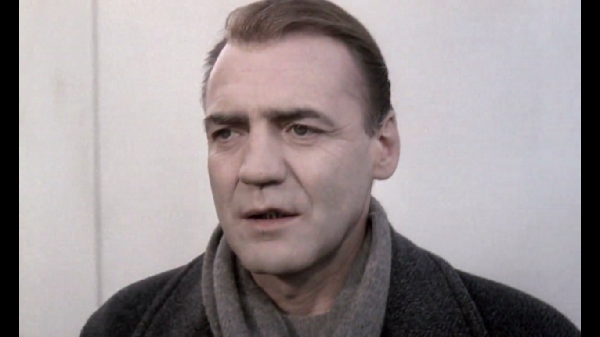

After an encounter with a stranger who helpfully introduces him to different colours, the camera follows Damiel on his way to a pawn shop in a long tracking shot. It is there that we notice another major difference from the way he and the world were filmed when he was an angel: Rather than gliding independently, the camera movements are now quite ostentatiously motivated by his own movements. Sounds are louder and clearer, signifying his clearer perception of the world in its totality.

After selling the coat of armour that was mysteriously dropped on him, Damiel ditches his angel uniform to buy different clothes. It is perhaps because his ability to see colour is so recent that his new wardrobe is so tacky: His loud tacky jacket, old grey hat, grey trousers and striped black, grey & white tie are comically mismatched. At this point, the beauty of Bruno Ganz’s performance shines through more than ever as the marvel of subtlety that it is: As an angel, he speaks very little. His eyes and posture express compassion and controlled longing. When, as a human, he arrives at the circus where Marion worked only to find an empty circle, he jogs around it, kicking the sand in anger and frustration with each stride much like an agitated child would. For a child he is, as far as tactile knowledge of the world goes. He is not unlike the child from the poem that opens the film and is repeatedly quoted by him; ephemerally happy with a life devoid of worries, fear or pain, yet hungry for existential knowledge.


After many efforts, he finally locates Marion at a Nick Cave & The Bad Seeds concert where he saw her earlier and the two greet each other as if they had always known each other – echoing the feeling of lifelong kinship many couples share. In a long, pensive monologue, Marion speaks of the loneliness she’s felt her entire life and of the positive loneliness she desires to achieve with a man and achieves with Damiel: To be lonely with him means to open herself to him and let him know her in every sense of the word. Communion with him means communion with the entire world.


That monologue holds the key to the closest thing Wings Of Desire has to a solution regarding the isolation of humans from one another. Unlike the well-acted and occasionally entertaining but comparatively shallow American remake City Of Angels, this isn’t a case of love conquering all. Rather, it is the meeting of two people who share the same fundamental and deeply human desires – to love, be loved and experience life at its fullest – while coming from two contrasting perspectives. In doing so, they achieve a symbiosis of sorts. As Marion puts it, they’re “representing the people now”. It is through this sharing of perspectives, this marriage between intellectual knowledge and hands-on experience that people have the best shot at better understanding each other and breaking down their emotional barriers.

1, 2http://people.bu.edu/rcarney/newsevents/wingsofdesire.shtml.